What’s happening to trust — Is AI destroying civilization?
Merja Haverinen
Communications Consultant
Trust is being tested in many ways right now. Deepfake videos and increasingly sophisticated scams are making people wary of media, social platforms, and even phone calls. AI is eroding credibility, because people can no longer be sure whether the content it produces is valid or not. That suspicion spills over from AI bots onto other people too: if someone’s content is clearly AI-generated, is anything they produce even true anymore?
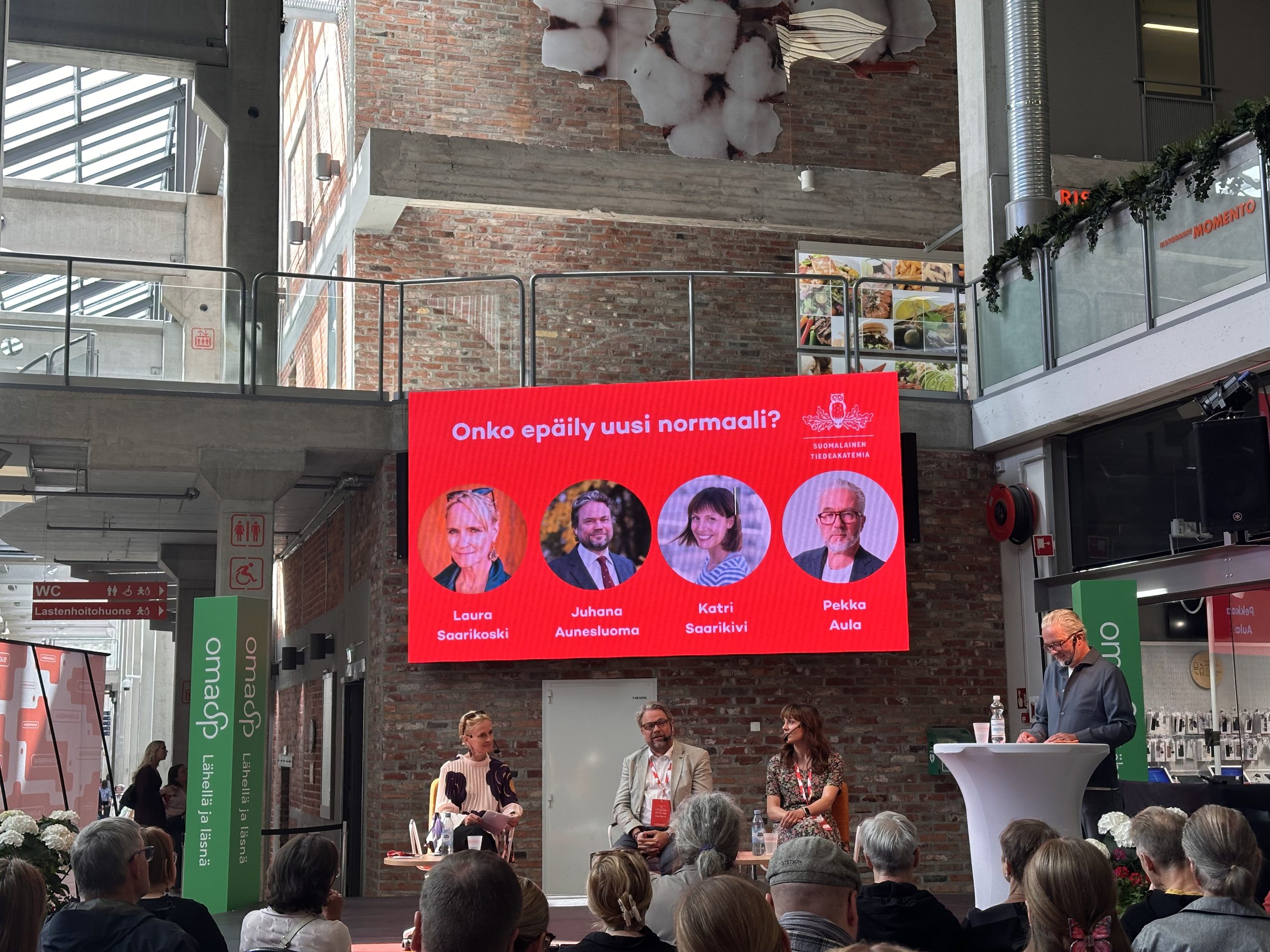
Trust was one of the main themes at this year’s SuomiAreena. Discussions at the event raised concerns about young people’s faith in the future, as well as citizens’ trust in politics and decision-makers, science, and the media. The question was whether trust in institutions is being tested, and how communication and technological developments are, unfortunately, currently undermining trust-building.
Read also: The most meaningful conversations at SuomiAreena take place off stage
During the week, trust was discussed by, among others, Juhana Aunesluoma, Professor of Political History at the University of Helsinki, brain researcher Katri Saarikivi, and journalist Laura Saarikoski. They too were concerned about the growing trust deficit. The discussion noted that healthy skepticism turns destructive once everything is doubted and nothing is believed anymore.
The causes were sought both in society and on social media. Aunesluoma and Saarikivi agreed that people have lost their sense of agency, which drives them to look for external explanations for their situation. Social media deliberately exploits our sense of threat: our brains are wired to conserve energy, so simple, oversimplified explanations appeal to us more than complex ones.
Laura Saarikoski has spent a lot of time in the United States and has observed that conspiracy theories are already extremely common there, believed by perfectly ordinary people — however hard that may be for us to believe.
Are we drifting into ever-worsening cross-currents of confrontation? Is a situation just around the corner where people splinter into small, competing, marauding tribes while Mel Gibson tears across the desert in a tricked-out car?
The panel offered glimmers of hope too, though. We are not defenseless against this development.
Saarikoski explained that, according to research, a sense of security grows when, instead of scaring people with talk of fake news, they’re taught what reliable information looks like and how to recognize it. In Finland, the media still enjoys strong regard, and it’s where people go to check whether something is true. Going forward, people will pay the media for reliability, not for a stream of news.
Aunesluoma pointed out that there is already so much information that our brains become overloaded. We need curated information and authorities to tell us what matters. The media, for instance!
Distrust is partly an illusion
In light of the research, the trust deficit hasn’t grown as severe as is often assumed.
The US-based research network More in Common has repeatedly demonstrated the existence of what’s known as the “Perception Gap”: people systematically overestimate how extreme, hostile, and dangerous others really are. The bigger this misperception, the more guarded people themselves become, and the cycle feeds itself. In reality, we’re less divided and less suspicious of one another than we think.
In Finland, trust in authorities and institutions has traditionally been strong. Here, for example, the media hasn’t lost its standing.
According to the recent Reputation&Trust 2026 study, Finns place particular trust in STT and Uusi Juttu, which receive the highest trust scores. Helsingin Sanomat and Yle follow close behind. Finns trust Yle considerably more than the British trust the BBC.
An OECD study published at the end of June, meanwhile, found that nine out of ten Finns trust the police and the defense forces. Nine out of ten!
Those are striking figures, and they suggest our country’s stability isn’t under much threat. I wouldn’t start hoarding gasoline or toilet paper based on those numbers just yet.
The perceived age of distrust and the measured level of trust simply don’t match up. Part of the dystopia, then, is an optical illusion — one that, ironically, social media algorithms actively reinforce.
Internationally, though, the picture looks different. The 2026 Edelman Trust Barometer shows that the standing enjoyed by institutions — government leaders, major news organizations, international business leaders — has declined markedly in recent years. At the same time, trust in one’s close circle, such as neighbors, family, and friends, has risen.
So it seems that trust itself isn’t disappearing — it’s simply being redirected toward different targets than before. Abstract authorities are losing their influence. People and humanity, on the other hand, are seen as worthy of trust.
Humanity is rising in value
Juhana Aunesluoma put it well at the SuomiAreena panel: face-to-face encounters are a human superpower. Political science research shows it to be the most effective way to resolve even the most serious international crises.
The same logic applies on a smaller scale to every brand and organization. When a distant authority loses its credibility, a person steps in to take its place: an expert with a recognizable name, a voice, and accountability for what they say.
Going forward, trust will be built by people showing up as themselves. We recognize the human factor when an expert appears under their own face, when an employee speaks in their own words, or when we meet someone face to face rather than through text alone. At the same time, the value of credible brands keeps rising.
So I’d venture to say there’s no need to start training as a survivalist just yet — at least not because of AI. Instead, it’s worth investing in being someone people trust.
At Netprofile, we coach your organization’s experts to take a stand, spark discussion, and present themselves convincingly — in other words, to build trust. Read more here.
Read also
What the YouTube algorithm knows about science communication that researchers don’t

From R&D to ROI: The last mile of innovation is communication