Uncertainty in the energy sector has grown markedly: geopolitical tensions, volatility in commodity markets and elevated security concerns have become the norm rather than the exception. The industry is witnessing both rapid, crisis-driven price spikes, as well as long-term cost pressures weighing heavily on European industry compared to global competitors.
On a societal level, goals include increased production, more flexibility and a more resilient power system. However, whether these investments come to fruition is no longer merely a matter of regulation or financing. Increasingly, the decisive factor is whether projects secure stakeholder acceptance – a social licence to operate.
The interlink between electricity markets, sustainability and communication is so tightly wound that the sector can no longer afford to overlook their interplay.
Investments aren’t halted by regulation but a lack of acceptance
The electricity price crisis of 2022 permanently reshaped European energy policy. In its aftermath, the EU overhauled the market framework with the aim of accelerating investment in renewable production and storage and flexibility resources, while providing safeguards to consumers against extreme price volatility.
For investors, financial incentives alone are not sufficient; political predictability is critical. When carbon pricing remains stable, investment logic remains intact – when it does not, project development is swiftly overrun by uncertainty. This perspective also aligns with the Finnish government’s objective, as per Yle’s coverage “is to improve predictability in the operating environment,” including support for clean energy investments and carbon capture.
The need for rapid energy investment is clear. Wind and solar power, battery storage, demand-side flexibility and new electricity-enabled industrial projects are all essential for achieving climate targets and strengthening security of supply.
As projects grow in scale, their impact reaches further, and the number of interested stakeholders increases. In practice, this means that a technically and economically sound project may face delays or collapse entirely if it is perceived locally as unfair, opaque or disproportionate. Opposition arises when people feel they have not been heard, impact is not transparently conveyed or promises are left abstract.
Therefore, acceptance is not a soft issue of reputation but a hard element of risk management: the larger the investment and capital requirement, the higher the cost of mistrust. While authoritarian systems can move quickly, democracies derive speed from transparency – through clear justification, open consultation and evidence on which decisions can confidently rest.
As Lauri Myllyvirta, founder and lead analyst at CREA (Centre for Research on Energy and Clean Air), noted in an interview with Uusi Juttu, the pace of clean energy expansion in democracies is not slower than in China – conflicts and trade-offs are simply more visible. When the rationale and processes are transparent, democratic systems can progress extremely quickly.
Securing a social licence is not a campaign – it is a process
The concept of a social licence may sound abstract, but in practice it is highly concrete. It is built on the perception of stakeholders that a project is:
- Justified – why it is needed and why it belongs here
- Fair – who benefits and who bears the impacts
- Transparent – what is known, what is still uncertain, and why
In the energy sector, social licences are earned from local communities, municipal decision-makers, landowners, authorities, investors and the media. Each holds a different perspective – which translates to differing expectations for communications.
Acceptance cannot be secured through a single press release or website update. It emerges from continuous dialogue with communication serving to clarify the project’s rationale and impact. Finland is a prime example of how the democratic process and rapid clean energy growth are not mutually exclusive. When reasoning and impacts are tangible, transition can happen quickly.
Sustainability is about actions – and that increases the risk of greenwashing
As sustainability requirements tighten across the energy sector, the risk of greenwashing also increases. This risk is rarely limited to blatant exaggerations; it often involves more subtle issues such as overly ambitious promises, vague terminology or claims that cannot be substantiated.
In today’s energy landscape, being “green” is no longer a sufficient explanation. Stakeholders – and increasingly regulators – expect clarity on questions such as: What is the basis for this claim? How are the impacts measured? What compromises have been made?
As investment numbers grow and public scrutiny intensifies, discrepancies between communications and reality will be uncovered swiftly. Trust is not eroded by imperfection but by failing to acknowledge it.
As Jyri Seppälä, Chair of Finland’s Climate Panel, notes in Uusi Juttu, technological solutions are vital, but their scale, cost and timelines make implementation slow. Climate action cannot rely solely on future technologies. Likewise, communication must clearly distinguish between what can be delivered now and what still requires technological or market development.
The transformation of electricity markets demands a new communication logic
The restructuring of electricity markets is creating a fundamentally new communication landscape. This is no longer about isolated projects but a broader transition in which investment is essential, impacts are unevenly distributed and decisions must be made amid uncertainty.
In this environment, credible communication is built not on promises but on the ability to explain, listen and demonstrate. At its best, it helps stakeholders understand why change is necessary – and what conditions come with approval. In practice, this means making the claim-to-metrics-to-evidence chain visible: every promise must be bolstered by clear methodology and trackable performance data.
For energy companies, this means communication, sustainability and business strategy can no longer function as separate domains. They converge precisely at the point where investment meets everyday life, the environment and public perception. When this chain is robust, trust from financiers and regulators is strengthened. Project acceptance is earned through evidence, not aspiration.
The new phase of the electricity market is therefore not solely a technical or economic shift – it is also a question of trust. Trust is built when reasoning, impact management and verifiability move in tandem.
At this intersection of technological, economic and societal expectations, communication becomes a critical strategic tool: it shapes a reasoned, verifiable and comprehensible narrative about why a project is undertaken and why it deserves to be approved.
If you are looking for support in planning strategically sound communication and building trust, get in touch with us.
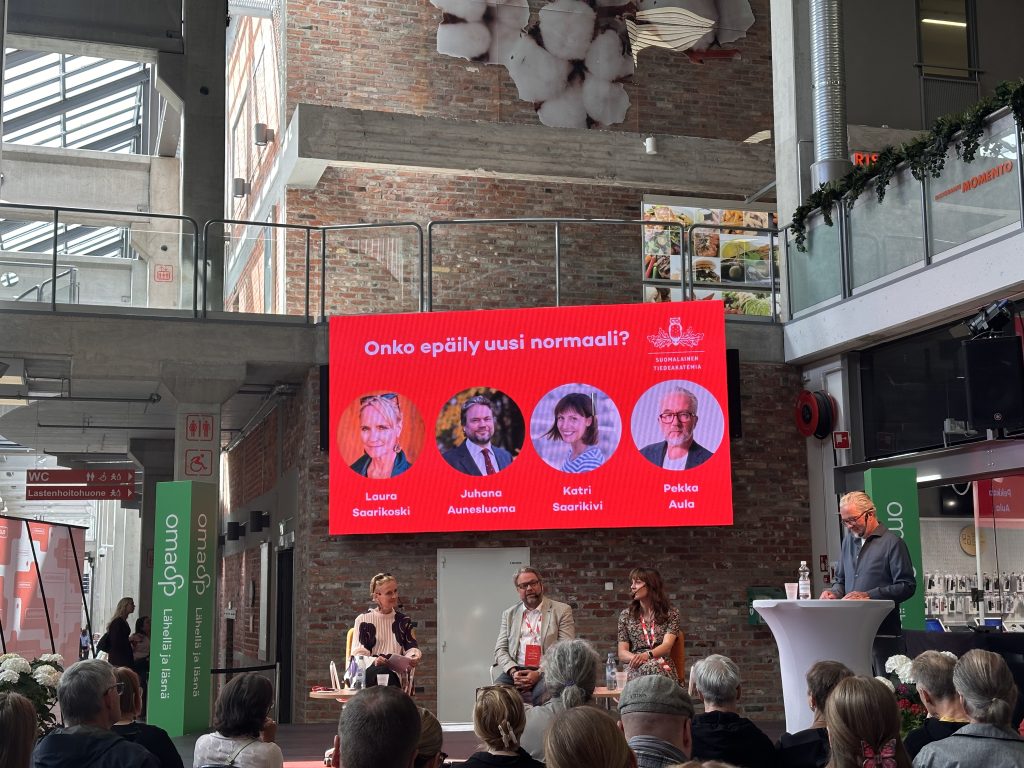
What’s happening to trust — Is AI destroying civilization?
The most meaningful conversations at SuomiAreena take place off stage

What the YouTube algorithm knows about science communication that researchers don’t

Payments down – cyber simulation, done?

Netprofile named Best Agency to Work for in Continental Europe at EMEA SABRE Awards – values-driven culture and cyber crisis expertise deliver four wins

AI 2026: From an Efficiency Pipeline to an Infrastructure of Power
Exceptional SABRE success – What’s the awards program all about?
Netprofile report: B2B leaders reveal – communications and marketing professionals offered a more strategic role in business
Nitor grew profitability by 23 per cent and strengthened its core business in a challenging market

Netprofile shines at SABRE Awards EMEA 2026: finalist in six categories

In the maritime industry, rescue training is routine – why don’t companies bother to train for cybersecurity emergencies?

Is sustainability dead?

5+1 tips for effective expert videos

When the production line stops without warning – how industrial companies prepare for cyberattacks

Finding your sweet spot: How IT companies can truly stand out

3 smart ways to generate standout content ideas in the energy sector

From R&D to ROI: The last mile of innovation is communication

Can AI be used responsibly?

Seven key manufacturing trends shaping 2026

Five communication tips for fintech – how to raise your trust capital

In financial services social media strategy is about trust and expertise

Web Summit 2025: The media landscape is shifting, Gen Z takes the lead, and AI Agents enter everyday life

Create a story before product development – new technology doesn’t sell itself

AI Doesn’t Explain Itself – That’s Why Communication Matters

ICCO Global Awards 2025: Netprofile Is the World’s Best Mid-Size Consultancy of the Year

Communications professionals, help save journalism!

ICCO Global Awards: Netprofile ranks among the world’s best communications and marketing agencies – two strong client cases selected as finalists

When a brochure just won’t cut it: 15 marketing ideas to dominate your next trade fair

Turning narrative into competitive edge – a trust engineer’s guide to fintech

Lust, pride, wrath…– the seven deadly sins in B2B communication

The big tackles are yet to come – how should enterprises approach AI adoption?

AI value hunt – and limited success

We wrote a report on AI in marcomms – here’s how AI helped us do it

Insight Track 2025 report: AI boosts marketing and communications efficiency – but where’s the competitive edge?

Netprofile’s award-winning team grows with two new talents

Silence is golden – but does this hold true in media relations?

Marimekko partners with Nitor and Hi Shine – aiming for a unique digital customer experience

Help! What to do when dominoes start to fall?

Beware of destructive denialism

Take LinkedIn by storm – Seven tips for aspiring thought leaders

AI dominates the media — will other tech topics only get the scraps?
AI + Industry = A Leap for Finland? Yes, with effective communication!

Master Meta-Skills and Thrive – A Communicator’s Toolbox for the Future
Nitor joins the Science Based Targets initiative to drive ambitious climate action
Ville Himberg appointed as Chief Commercial Officer at Nitor

Cyber crisis simulation helps ensure business continuity
When Project Management Succeeds, the Team Thrives – Lessons Learned Through Lego Play

“German audiences value thoroughness and authenticity”, says Markus Engel of Communication Consultants
Insights from a Week Immersed in Stuttgart’s PR World

Netprofile’s success at the ICCO Global Awards continues – reaches the finals of the prestigious international communications competition
5 key learnings from the Nordic Business Forum for communications professionals

In a cyber crisis, you quickly run out of time and money – Here’s how to boost your resilience

So, what’s up in tech comms? And what does Esko have to do with it?

Netprofile dashes to the finals of the Finnish Comms Awards 2024 in five categories

Finding clarity when your strategic horizon is blurred
Nitor appoints Pasi Niemi as Vice President, R&D

I think, therefore I am a thought leader? – AI raises the bar, and only a few will clear it

Netprofile Industry Report: AI has a huge impact in tech PR and marketing – action required now

Netprofile Industry Report: AI Has a Huge Impact on Tech PR and Marketing – Action Required Now
Nitor has appointed Santtu Vuori as the Managing Director in Sweden

The quantum threat is rising – why should every company take note?

The answer is why – creating a successful podcast often boils down to answering one simple question
Heini Dahlström of SOK receives Agile Influencer of 2023 Award

Netprofile picks four Sabre EMEA awards finalist spots – green transition propels success

Netprofile Joins GlobalCom – Now Offers PR and Marketing Services in 100+ Markets

Dollars and data: How much is it for a social media lead?

Triple triumph – Netprofile and clients propel to finalist spots at ICCO Global Awards 2023

Wow! Finland is full of awesome communication!

Geopolitical tensions and the ethics of AI met in Warsaw

Netprofile reaches Finnish Comms Awards 2023 finals with four client projects

Native advertising, yuck!

Jukka Holm: Work Must Never Stop – Ever!

Your digital footprint after death – What happens online?
Speeding up sustainability – we set science-based targets for our climate work